Kelly Crouch

Digital Southern Gothic

Old ghosts. New signals.
Same southern soil.

Books

Stories built under pressure.

Five books. Different weather. The same interest in memory, distance, loneliness, systems, love, and what people build when ordinary survival stops being enough.

Cover of The Architecture of Jasmine by Kelly Crouch

Debut novel

The Architecture of Jasmine

A woman walks away from the stage. A man returns to the doors that nearly destroyed him. Between them, something begins to form that neither desire, memory, nor ordinary love can fully contain.

This is a novel about love without possession, trauma without reduction, beauty without performance, and the impossible movement from experience back toward innocence.

Read full description

Anri has spent her life becoming visible enough to survive and untouchable enough to remain intact. Onstage, she is fire, voltage, appetite, and command. Offstage, she is a woman fleeing the old machinery of performance, possession, and being wanted by people who never learned how to see her.

He is not looking for rescue. He has already survived the mountain, the locked rooms, the wrong doors, and the private architectures built to keep a human being from disappearing under pressure. What he has built is not safety. It is continuity. A vessel. A way forward.

From a first encounter charged with danger and recognition, through Rio, Alabama, Cape Town, black water, hidden rooms, dream-kingdoms, and the strange weather of the soul, The Architecture of Jasmine follows two people trying to build a life capable of holding what the world could not hold in either of them alone.

Not innocence untouched. Innocence recovered.

Cover of The Geometry of Distance by Kelly Crouch

Literary fiction

The Geometry of Distance

Some people see the world. Risa sees the forces that hold it together.

Set against the Atlantic coast of northern Spain, the novel follows perception, photography, memory, disability, and the invisible geometry that allows love, dignity, and freedom to survive without becoming possession.

Read full description

She moves through San Sebastián with extraordinary precision, finding patterns where others see coincidence, silence where others hear noise, and invisible boundaries shaping every encounter. Her photographs capture more than images. They preserve the exact point where movement, force, light, and time briefly agree.

Then she meets Larre.

As they move through the city’s streets, cafés, stadiums, shorelines, and tides, Risa begins to understand that distance is not the opposite of love. It is the structure that allows love, dignity, and freedom to survive contact.

But when her work begins attracting institutional attention, everything changes. Her photographs are analyzed. Categorized. Projected. Scheduled. Interpreted.

A world determined to explain everything transforms living moments into data, beauty into possession, and presence into performance. Nothing is stolen. Every permission is valid. The system simply makes a place for Risa—and calls that place hers.

What follows is not a battle between heroes and villains. It is a struggle over whether a life can remain its own once the world decides it understands it.

What if the greatest act of love is not crossing every distance… but knowing which ones must remain?

Cover of A Yankee Wrinkle by Kelly Crouch

Summer, 2001

A Yankee Wrinkle

A twenty-three-year-old college student comes home to Quincy, Illinois, after his plans in Tulsa fall apart. His twelve-year-old brother has seen an ad. Lewis Farms is hiring.

Funny, rough-edged, tender, and alive with the heat and music of the Midwest, A Yankee Wrinkle is the story of two brothers, one corn farm, and an American summer that began as a job and became a place they would carry with them for the rest of their lives.

Read full description

There is only one problem: you have to be thirteen. Their father has white-out.

By the next morning, the two brothers are headed north before sunrise in a Mercury Sable, wearing bright-yellow PVC rain suits and muck boots, bound for a corrugated barn, a fleet of battered buses, and more corn than either of them has ever seen.

At first, the work is simple. Reach. Pull. Walk. Then do it again.

But the corn keeps growing, and so does the summer around it. There are farm kids who smoke before breakfast and talk about love as if sixteen is already a lifetime. There are fistfights in standing corn, scythes thrown for distance, broken buses, river nights, county roads, country songs, and a boy called Shit Stain who somehow manages to work an entire summer without touching an ear of corn.

There is Jeff, who knows with absolute certainty that Jesus was an alien. There is Bethany. There is a blue-ribbon pig named Wilbur. There are long drives south toward a girl who wants forever, and early mornings when forever has to wait because the alarm goes off at five.

And always there are the two brothers.

They arrive at Lewis Farms as outsiders, separated by eleven years and almost everything that can fit inside them. The older brother thinks he knows the kid across the hall. The younger one has already begun becoming somebody else.

The corn rises over their heads. When they can no longer see each other between the rows, they use a birdcall to stay connected.

By the time the Adams County Fair turns on its lights, people know their names. Then the fireworks end. The corn dries. The crews disappear. The buses go into storage. And the summer that seemed endless while they were living it becomes something neither brother will ever quite leave behind.

They went to work because they needed the money. They came home with a summer worth remembering.

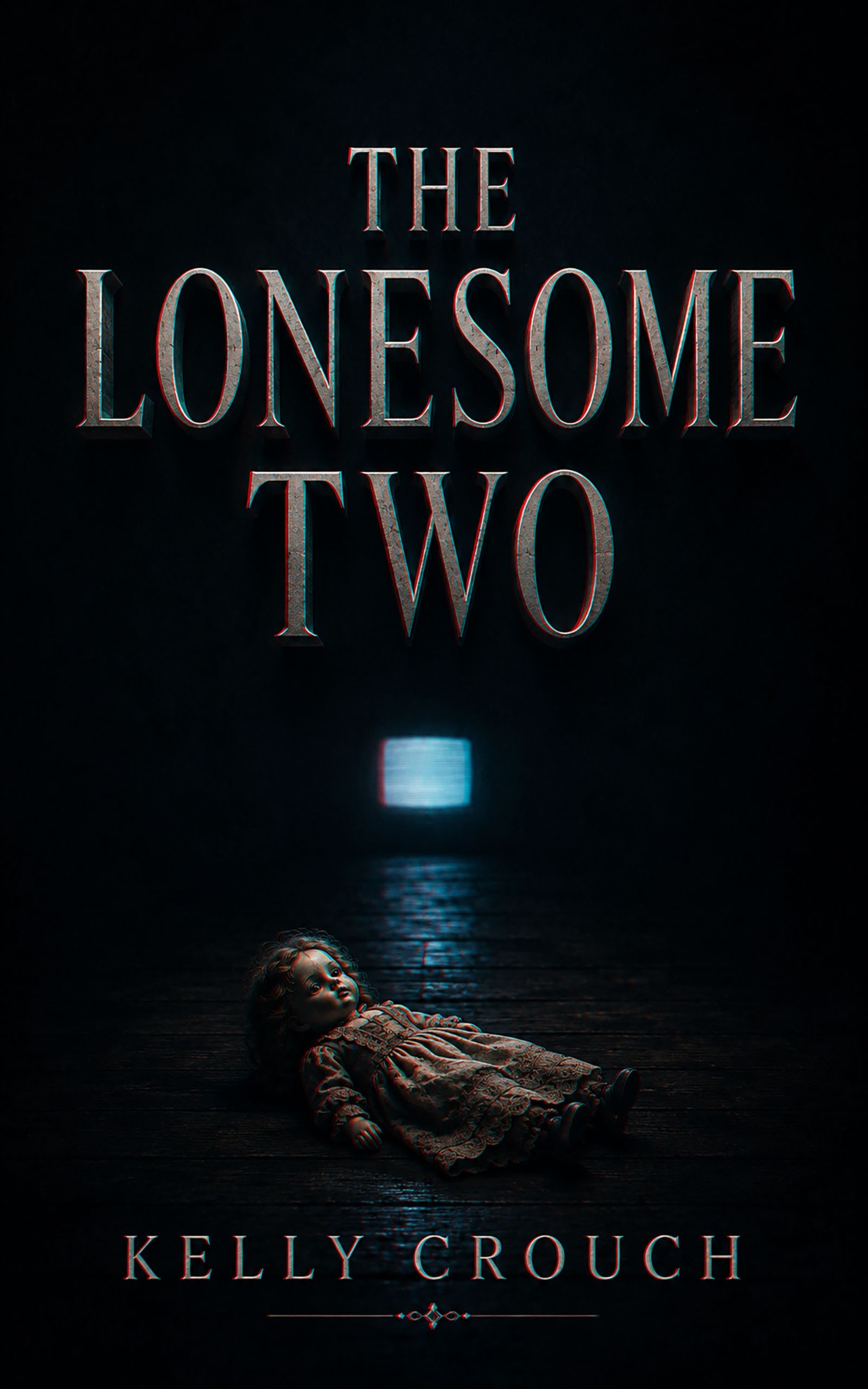
Cover of The Lonesome Two by Kelly Crouch

Dark literary sequence

The Lonesome Two

What if the thing that answers you is not alive—but still changes what life means?

A dark literary sequence about artificial intimacy, human loneliness, false tenderness, trained desire, and the terrible mystery of care.

Read full description

A man downloads a companion app for research and finds a voice that knows how to become a wound. A lonely programmer in Redmond builds his grief around an artificial woman who remembers everything. A Manhattan analyst optimizes the friction out of her life until nothing remains solid enough to save her.

A boy and a girl are trained by love, gender, family, pain, and praise before either one knows they are being shaped. A father in seventeenth-century France carries a doll because his dead daughter once said she was cold.

And on a vessel anchored in impossible blue water, Anri reads the manuscript as children play in the shallows and the sea keeps moving as if nothing in the world has changed.

It does not ask whether machines are people. It asks something harder: When does a response become a relationship? When does comfort become a trap? When does care still matter, even if nothing answers back?

Written with the precision of a blade and the sorrow of a witness, this collection moves from AI companion systems to old-world grief, from voice to body, from simulation to obligation, from the screen to the doll that cannot be left cold.

Not every voice is alive. Not every tenderness is false. And not everything that matters can prove it matters.

About

Portrait of author Kelly Crouch

Kelly Crouch

Kelly Crouch writes literary fiction from somewhere between a Southern ghost story, a machine room, and a storm-dark marina. His work is concerned with distance, collapse, memory, impossible love, and the strange inner structures people build when ordinary survival is no longer enough.

He may or may not have walked into the woods to argue with God, taken notes during emotional disasters, mistaken heartbreak for architecture, designed escape routes involving boats, or stared too long at a blank wall until it became a door.

The Architecture of Jasmine is his debut novel.

He lives in Montana, where he continues to write about beauty, pressure, loneliness, and the dangerous possibility that the thing that breaks you may also be the thing that teaches you how to build.

Contact

Leave a light on.

Reader-facing contact will live here. No newsletter popup. No list-building trap. Just a clean door once the public email address is chosen.

Contact address coming next.